Role page: Sales
I wrote this page to position IBISWorld for a sales audience: fast, direct, and deal-focused.
Marketing Leader & Strategist · Writer · Content Producer
A growth marketing leader who still creates alongside my team. Experience spans a decade of building campaigns that grow pipeline across web, email, product, content, demand gen, and brand.
Selected Results
Web Content & Strategy
I own the voice and tone across ibisworld.com and manage the copywriters who produce it. I write, edit, and set the strategy. I wrote every role page on the site, pitching the same product to distinct audiences with different values and needs.
I wrote this page to position IBISWorld for a sales audience: fast, direct, and deal-focused.
I wrote and reframed this page for consultants: defensible, credible, and client-forward.
Directed and edited the copy my team produced across roles, industries, and use cases.
Email & Lifecycle
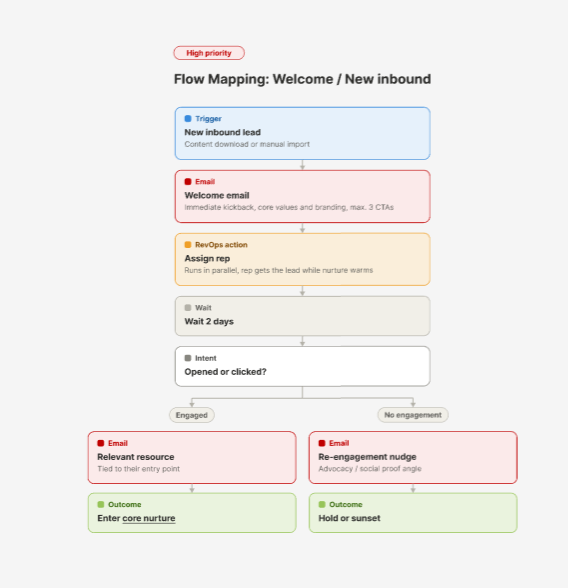
I write emails. I also build their infrastructure.
This is an automation for our inbound leads, taken from our larger lifecycle automation.
Part of our integrations/API/AI campaign that grew email revenue from $140K to $650K in two quarters.
Campaign grew revenue $650K+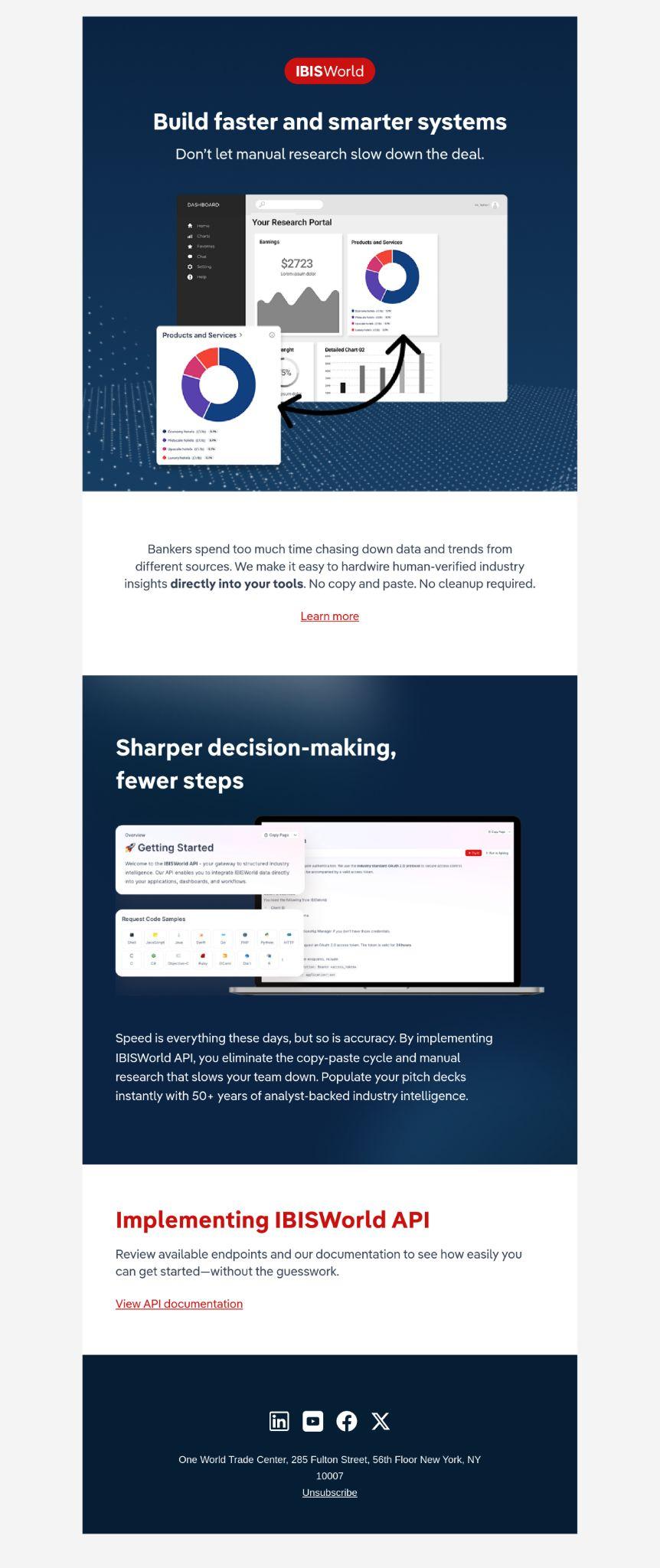
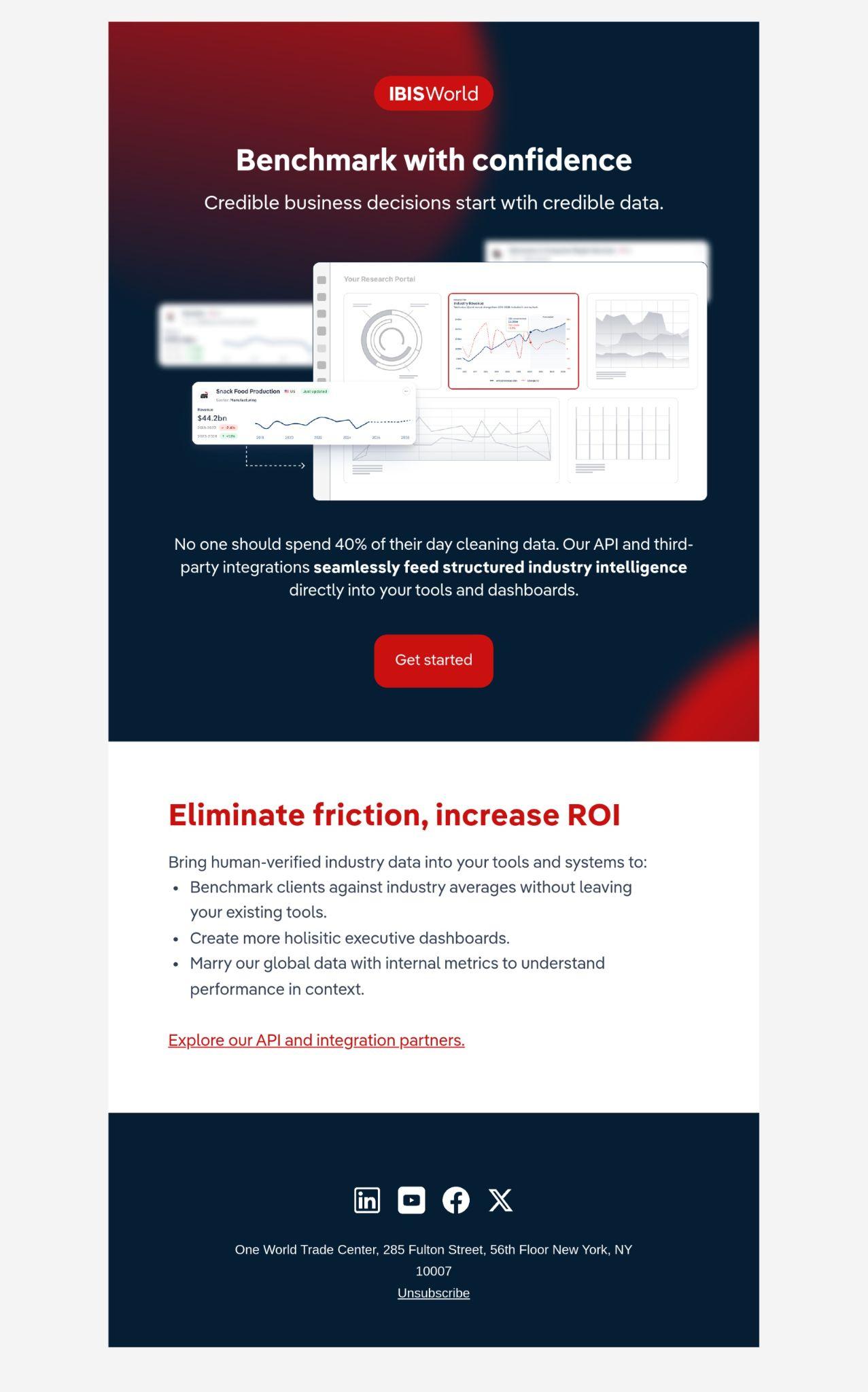
This is the same campaign, but several emails downstream.
Content
Pieces I ideated, managed, and produced. These are part of the greater integrations and AI campaigns I owned.
Ideated, managed, and produced. Ammunition for salespeople to hedge against the “I can get your premium product with AI for free” objections.
Product collateral for the Snowflake Marketplace launch. This translates a technical, complex product into something easy to understand and purchase.
I owned the concept, coordination, promotion, and production.
Long-form & Editorial
Writing craft that isn’t an email or brochure.
Long-form narrative interview of a staff member.
It’s a sunny, warm Thursday late in the afternoon. Spring in California is like summer elsewhere: high temperatures in the 70s and lows in the 50s. Longer days of sunlight are a pleasant change from the dull grey of winter. Most Los Angeles residents take the opportunity to enjoy iced drinks, play backyard sports, and host a barbecue or three before the summer turns scorching.
Anthony Samaniego, 35, might like to join them. Instead, after a long day at work, he closes his company-issued laptop and opens another. He has homework to do. After two years of supply chain school–and ten partnering with procurement and supply chain practitioners as a key member of ProcurementIQ’s team–he’s just a few months away from completing his master’s degree at Michigan State University’s prestigious Eli Broad College of Business.
The Master's in Supply Chain Management program takes an average of two years to complete. That’s the timeline Samaniego signed up for. Most people will see his degree and understand the two years of commitment and hard work he dedicated toward that venture. But the hard work began long before enrolling in Michigan State, and his voyage from sales to supply chain was more than ten years in the making.
A self-described “data junkie,” Samaniego joined ProcurementIQ, the market intelligence arm of IBISWorld, back in 2015, near the company’s beginning. While ten years may not seem very long next to the hundred-year history of supply chain management, the amount of change the world—and by extension, procurement and supply chain—has experienced during the last decade is nearly unprecedented.
“It’s a constant evolution."
When asked if he’s seen it all, he’s emphatic. “No. I think if we look at the tariff situation and the challenges it’s posing for supply chains, we’re in unprecedented territory. So saying I’ve seen it all when I’m currently living something I’ve never seen before would be lying to myself.”
There are plenty of reasons college graduates might gravitate toward supply chain, in part due to that constant evolution: job security, salary, room for growth. Per the U.S. Bureau of Labor Statistics, the job market for logisticians is projected to grow 19% between 2023 - 2033. With geopolitical conflicts, pandemics, tariffs, labor disputes, and other supply chain-affecting crises demanding every ounce of effort practitioners can muster, the job function will only grow in importance.
That said, being responsible for mitigating risks that can be difficult, or impossible to foresee, is a huge stressor not everybody can shoulder.
But for Samaniego, juggling external factors while planning for the future was what drew him to the job function in the first place. “I had tunnel vision before the supply chain program,” he says. “I didn’t have a good enough understanding of those external components, the ripple effects that change how procurement or an organization has to source something as a whole.”
“Local-level events have ripple effects that reverberate across supply chains and organizations, so that’s ultimately what gets me excited about the space. You can’t really foresee what’s going to happen tomorrow.”
After a decade working for ProcurementIQ, Samaniego has experienced worldwide supply chain crises firsthand. “There’s a constant push and pull,” he says on accounting for disruptions. “For me, that’s where data, market intelligence, even AI all play a role in helping arm supply chain professionals with the right information, and timely information, to pivot as quickly as they can. It’s going to put you in a better position to make decisions.”
"The more informed you are, it ultimately helps eliminate blind spots and pitfalls you might not think about.”
Blind spots and pitfalls are common in every job function, just as they’re common in life. Though his experiences alongside procurement and supply chain practitioners eventually led him to adopt their credos and follow in their footsteps, that wasn’t always the case.
“That’s been my biggest shift during my time [at ProcurementIQ],” Samaniego says of his experience. “I was so focused on selling at the start that I didn’t do a good job of pivoting. You know, how I was positioning our products. But supply chain school helped me stop thinking about it like a salesperson."
“Now I really just view myself as an educator."
The challenge is what makes supply chain so rewarding for Samaniego: "The beauty of this space is I can talk to five businesses in the same industry and talk to the same function, but they’re facing vastly different challenges.”
For the past two years, Samaniego’s goal has been simple, if challenging: raise his daughter, work with procurement departments daily, and graduate with his master’s degree. It hasn’t been easy. It’s required long hours of study after a demanding full-time job and working together with his wife to raise a family. Despite that, he’s all grins when asked how he manages to juggle a busy schedule. The answer is simple: he approached supply chain school like a practitioner might. “My wife and I set a plan for healthy boundaries and time management before I started the program. It’s never gotten to the point where I felt like it was detracting from my family time or my relationship with them.” Though, he admits, it was a demanding two years.
With graduation on the horizon and a new role with ProcurementIQ as a client relationship manager ahead, Samaniego looks to an ever-changing future with both his newfound supply chain expertise and his place of business.
As ProcurementIQ plans to implement sweeping new product updates this fall to better enable practitioners to see their sourcing landscape from a top-down perspective, Samaniego is preparing to guide clients through the next era of strategic sourcing.
“You can’t do any of the things supply chain will be at the forefront of," he says, "without having the right team to bring resources and solutions forward to make them a reality."
"There’s so much unknown ahead and supply chain is what brings all groups together.”
In May, Samaniego will walk with the other graduates from his class and receive his Master’s in Supply Chain Management. It’ll represent the end of one life chapter in more ways than one. After ten successful years as a salesperson at ProcurementIQ, Samaniego will take advantage of the company’s investment in employees to transfer to its client services department, where he’ll apply his education directly with supply chain and procurement practitioners.
From soliciting client feedback for future product rollouts to ensuring clients receive the maximum ROI possible from their ProcurementIQ membership, Samaniego’s expertise will lend a new dynamic to an already veteran team of client relationship managers that were on the forefront of ProcurementIQ’s upcoming product updates.
Follow ProcurementIQ on LinkedIn to get notified of the latest procurement news and market developments from our experts to yours.
Bylined sports writing for SB Nation. Voice and style-forward for a sports audience.
More bylined writing. I covered more losses than any other writer that season.
Systems
Governed and operationalized AI for marketing teams.
I led the build of a content system—a core brand-guidelines skill with channel-specific voice/tone skills layered on top (LinkedIn, articles, email, webinar pages), 15 skills in all. Now used by a team of 8 to speed production and hold voice consistent.
Used by a team of 8An excerpt from the brand copy skill. The core set of references governs 15 channel-specific skills. This is a piece of the brand copy skill, not the full structure.
Use this skill whenever writing, editing, or reviewing any content that represents IBISWorld. Read this file fully before starting, then consult the relevant reference files for deeper detail.
Who IBISWorld is. Founded 1971. The world’s leading provider of industry research. Persona: The Trusted Advisor — supportive, down-to-earth, committed to helping clients make confident decisions.
Voice in one line. Clear. Confident. Informative. Conversational. Never academic or artificial. Always client-focused, never company-focused.
Task routing. Writing copy → read the voice-and-messaging reference (client-focused “you,” benefits before features, tone shifts by context). Writing boilerplate → read the about-us reference. Reviewing copy → audit against voice, client-focus, editorial style, and anti-AI rules.
Coming Soon
In progress — the next things I'm publishing.
This takes internal research and restructures it into thought leadership backed by data. We conducted on revenue wins, losses, renewals, and churned accounts to understand who shows up in deals, what they care about, and what their presence or absence means for revenue.
Funny anecdotes from our research staff that illustrate the dangers of ungoverned AI. It looks like it’s just for fun, but it helps revenue staff sway at-risk clients or prospects who think a ChatGPT Pro account is a risk-free substitute for millions of human-verified data points.
Fiction
More craft that isn’t an email or brochure—or a recap of the Devils losing yet again. This excerpt features Ash, the sardonic first-person POV, and her accidental alien ward as they try to survive a high-stakes moment.
Dusk.
The maluraii stumbled. He’d been in bad shape for miles, but he’d never complained. Never asked to stop and rest. I respected that. He knew as well as I did that nowhere was safe. Distance was our only chance. We might’ve dodged the Night Folk’s thralls at the river crossing, but I knew better than to think we’d lost them for good. And Vertex was out there with his maculae . . . somewhere.
He tripped, falling.
“All right,” I said. “Enough. Time to hunker down.”
“I will continue.”
“No. You won’t.” I scanned the area for cover. “Do you smell them?”
“Who?”
“Night Folk. Thralls of Night Folk. Maculae—the ones who attacked us at the Dream. Other psionics. Bounty hunters, thieves. Anybody or anything.”
He sniffed without moving. “No.”
“Then we’re done for the day.”
We sheltered inside the skull of a dead predator, the hollowed recesses just wide enough to share space. Rain drizzled through the cracks.
“I’ll take first watch this time,” I said.
“No. I will not sleep for some time.”
“You should try.”
“I am,” the maluraii said, chewing over the right word, “too energetic.”
I opened the fourth pouch from the left on my belt, took out wire and rattlers. “Valerie was the same. Never could sleep after action. But me? I can sleep anywhere.” It took less than ten minutes to string the rattlers and line our makeshift camp with wire. When I returned, the maluraii was awake. “If you go outside to take a piss, don’t hit the rattle-wire. I’ll shoot whatever touches it. Won’t have time to check if it’s you.”
“Hnnh.”
Third pouch, right—I broke the last of my jerky and tossed him half. He snapped it midair.
“This Valerie,” he said. “She is your sister?”
“Sort of. We’re not related. Just grew up together.”
“You are close?”
I chewed. “We were.”
He was silent. I knew the look in his eyes, so human for something inhuman: he’d gone somewhere else in his mind.
“Maluraii aren’t common around here,” I said.
“No.”
“Your family . . . or your pack . . . where are they?”
“Where I left them,” he said after a pause. “Far from here.”
I struggled to realign the broken shards of my dream. “The Dawn knights found you on a beach. Not with your family.”
“Yes. I . . . left. I was a danger to them. They are safer with me gone.”
“Because of your psionic bleed?”
“Because,” he said, “of who I am.”
A thunderous crash somewhere far away interrupted me mid-reply. I drew my gun and stuck my head out of our makeshift shelter. It was fucking dark. Sanct-dwellers never understood how dark it got at night, especially when it was raining. “Dog—what do you smell?” I asked him.
His ears swiveled and his nose twitched. “A beast. It smells like a village. It smells like a mass grave.”
“Arastok. He’s awake.”
“Who?”
“More of a what,” I said, withdrawing inside and dropping to the mud. After a moment, I pulled him down beside me. “Keep your head down. Stay absolutely silent.”
We both stilled. Listening. Waiting. I heard him now: his grunts had disguised themselves in the roiling thunder, but as he approached, each of his steps were an avalanche. Each step jangled the rattlers on my line. I couldn’t pick him out from the utter blackness, but the stench announced him long before his shape appeared on the hillside. My eyes watered. Spoiled meat sour undercut by musky, damp carpet.
The maluraii held his breath.
Through the hollowed, broken eye socket of our skull, we spotted his silhouette. Then lightning forked, illuminating the King of the Frontier: the beast Arastok. He stood twenty stories at his zenith, dense and long like a monstrous bear whose head nearly scraped the clouds on his hind legs. The cords of his foul, ropy hair dripped months of collected dirt, blood, and carrion, a second rainstorm that clattered off our shelter. Small bones fell into my hair. Bird, maybe. I did not move. His every step shook Ertah’s crust, clattered my teeth, and sent shockwaves up my ribcage.
Arastok trudged overhead.
His immense belly teemed with corpses and writhing bodies twined into the netlike tangles of his fur. Some of them were still alive. They screamed. I wasn’t the praying type, but if I was, I would’ve prayed then.
Arastok’s strides took him past our camp and into the edge of the forest a quarter-mile away. Trees splintered as he carved a thoughtless swathe. After a time, his steps faded into the background chorus of thunder, and I breathed easy again.
“Never thought I’d see him up close and live,” I said.
“What is he?”
“No clue, but we’re lucky there’s only one of him.”
“He was hungry.”
“Yeah. I know for a fact more’n a few towns around here make offerings. Stukka, grassfowl, stuff like that. But it’s been a lean summer.” Arastok didn’t care where his meat came from, so long as it was there for the taking. Who would draw the short end of the stick and join the teeming mass entwined below his belly?
The maluraii sniffed. “Everything ran away.”
“Anything with a brain runs from Arastok.”
“Except for us.”
I snorted. “Yeah. ‘Cept for us. Stay here.”
The bones in my hair were a mix of skynt and squirrel, as it turned out. I discarded them in a small hole I dug within the rattler line, which I straightened. The maluraii’s bright eyes were waiting for me when I came back.
“I’ll need you to take over the watch in a few hours. You should sleep while you can.” He blinked. I snapped my fingers in his direction. “You—did you hear me?”
“Yes.”
The maluraii slunk to the farthest, driest corner, where he curled into a ball. Time passed. Aside from the pattering rain and the thunder, a deathly stillness had settled around us like a funeral shroud. Even the cicadas had stopped. Quiet did not suit the frontier. It made me antsy. I shifted around the confines of our shelter, varying my point of watch at random so nothing could pick out a pattern and sneak up on us.
Maybe an hour later, the maluraii rolled over. He was awake. Probably had been the entire time. “What?” I said.
“You called me ‘dog.’ I am not a dog.”
“Yeah, well, it rolls off the tongue easier than ‘maluraii.’”
“That is what I am,” he said. “It is not who I am. I have a name.”
“Okay. Me too.”
“Should I call you ‘human?’ Or perhaps ‘primate?’”
I moved to a different vantage point. One where I couldn’t see the maluraii’s disturbing gaze. The rattler line had been quiet since Arastok had moved on. I would’ve liked to have shot something by now. Like the frontier, quiet didn’t suit me.
I sat, looking into the night. My eyes conjured images to fill the nothing night pressed against us. Blackness became whorls of flames. When the Dream had burned, I’d grabbed the maluraii before I’d jumped. It had felt like the right choice at the time.
He was a magnet for trouble. Worse, he was a volatile psionic who couldn’t stop his powers from escaping.
“If not dog,” I said, “or maluraii, what should I call you?”
The rain became a downpour.
“My asur name is forfeit,” he said. “Kolya called me Legion.”
I remembered now. Kolya had said that on their holorecording the night they’d died. Felt like years ago instead of a few short days.
“Why Legion?”
“They told me it was ironic,” said the maluraii, “but I do not know why.”
I watched the rain for a long time. The maluraii kept shifting in his place.
“You’re safe,” I said, turning to face him. “You can rest now . . . Legion.”
After a few minutes, his ragged breaths steadied, became deeper, and he drifted off to sleep.